A forecast you could turn by hand
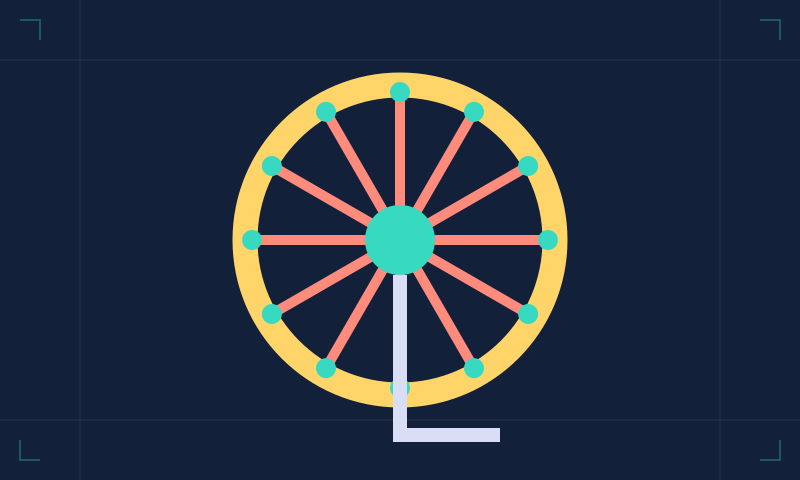
William Thomson, later Lord Kelvin, worked on a machine built by A. Légé & Co in 1872 that combined ten tidal components. Geared shafts and adjustable cranks helped turn those repeating contributions into a drawn curve. The Science Museum Group describes an annual prediction for one harbour taking roughly four hours. Rather than repeatedly doing the arithmetic on paper, the mechanism performed the combination physically.
More than one rhythm
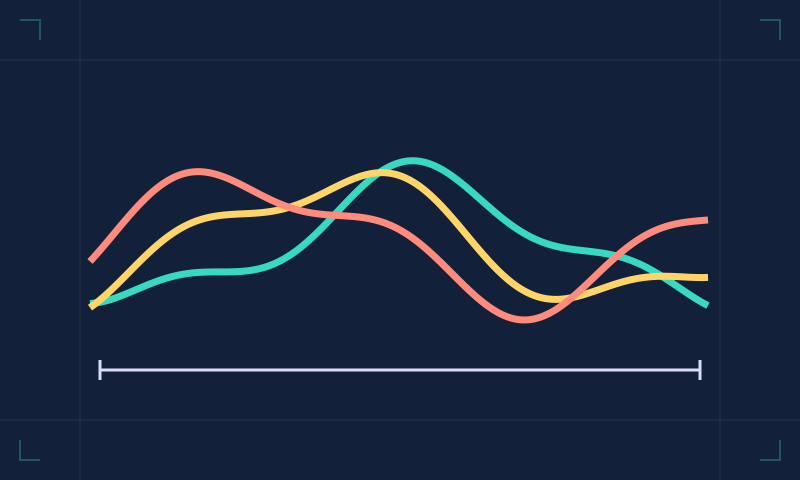
Imagine two transparent sheets, each carrying a wave. Move a finger along them and add their heights at each position. Sometimes the waves reinforce one another; sometimes one cancels part of the other. A tide machine makes that kind of addition continuous. The striking thing is not that a single crank can go up and down. It is that a collection of regular motions can create a line with a much less obvious shape.
Place belongs in the calculation
The settings were for a particular harbour. A tide prediction is not a universal timetable you can simply reuse elsewhere. Nor does this historical machine offer a safe way to plan a present-day trip. Weather and local conditions matter, and a museum explanation is not current navigation information. Use the relevant official tide and safety advice for any real coastal activity. Here, the object is an invitation to understand a method, not a substitute for a forecast.
Sketch the idea
On squared paper, draw a slow, broad wave. Under it, draw a smaller wave that rises and falls twice as often. Choose six equally spaced points and add the two heights, treating heights below the middle line as negative. Plot the six answers. Join them gently rather than forcing them into a perfect wave. You have made a tiny numerical version of the combination the machine performs. Try moving the smaller wave sideways and compare the new result.
Why this belongs in a digital magazine
We often treat a calculation as something invisible that happens inside a chip. A mechanical calculator gives each part of the process a visible shape. It also makes its assumptions easier to ask about: which contributions are included, how are they adjusted, and what has been left out? Those are useful questions for a spreadsheet or an app too. An impressive output is still an output from a model, and understanding the model is part of understanding what the answer can tell you.
TAKE ANOTHER BYTE
Find a page for a small experimentSources & further reading
References support the historical or technical facts. Paper exercises and comparisons are our own explanatory activities.
Researched and written with AI assistance, edited for the Really Byte collection. Spotted an error? Tell us. Read our editorial approach.